Independent verification of AI content · Updated daily
“Codex now reviews Claude's code and finds critical flaws”
Claude Code + Codex = AI GOD
This video demonstrates the integration of OpenAI's Codex model into the Anthropic Claude Code ecosystem. It highlights Codex as a cost-effective alternative or complement to Opus 4.6 for tasks like code review and generation. The creator walks through the setup process, showcases Codex's 'adversarial review' feature to identify code issues, and compares its performance with Opus, advocating for the combined use of both models to enhance code quality and efficiency.
Recent analyses
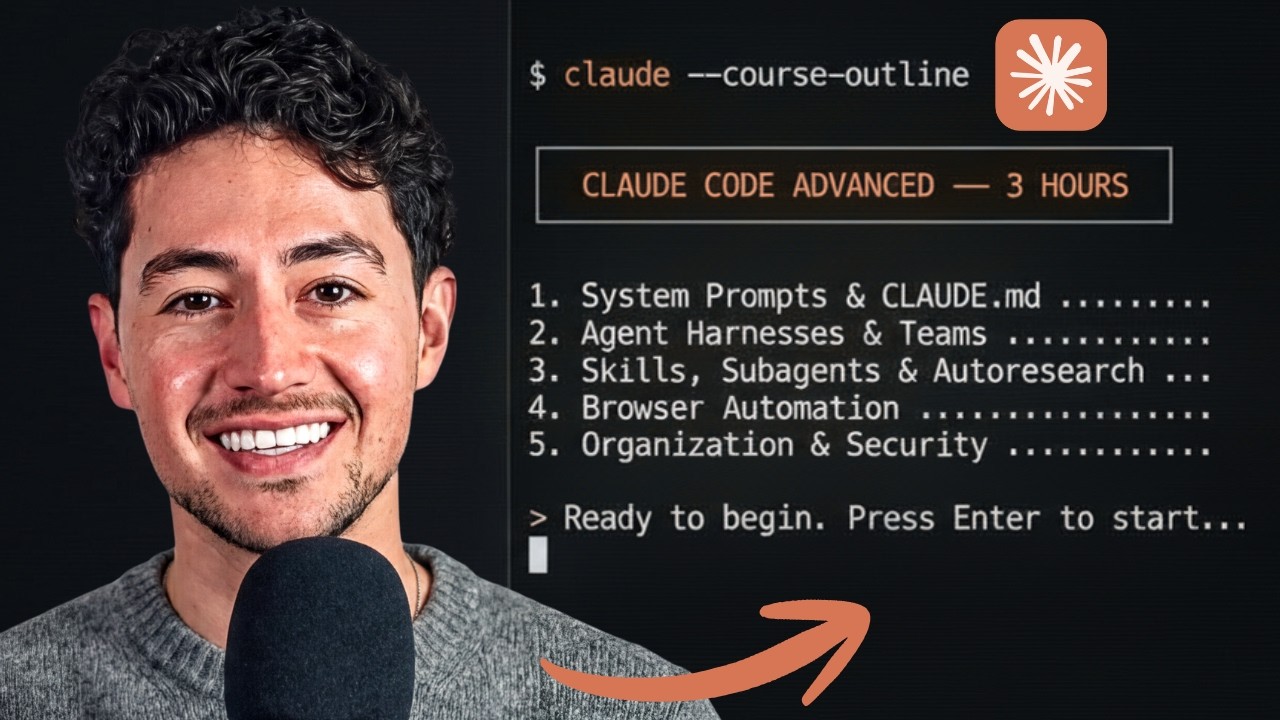
View all →CLAUDE CODE ADVANCED COURSE — 3 HOURS
This video introduces an advanced Claude Code course for users with foundational experience, focusing on optimizing `claude.md` and system prompts for improved quality and efficiency. It covers advanced topics such as building agent harnesses and teams for task parallelization, organizing skills and sub-agents, applying Karpathy's auto research approach, and browser automation. The course also addresses performance fluctuations, workspace organization, security, and provides insights into the future of AI and work.
Claude Code + Paperclip Just Destroyed OpenClaw
This video introduces Paperclip, an open-source orchestration tool designed for creating and managing 'zero human companies' powered by AI agents. It demonstrates how to set up various AI roles like CEO, marketer, and designer, enabling them to automate business tasks, manage budgets, and collaborate. The creator showcases Paperclip's integration with Cloud Code and its dashboard for monitoring agent activity, task progress, and overall company operations.
El backend para developers que usan IA: InsForge
The video introduces InsForge, an alternative to Supabase, highlighting its AI agent-driven backend configuration. The creator demonstrates building a NextJS Kanban board application, showing how InsForge's agents can set up authentication, database, and server-side logic using natural language prompts. The process involves initializing a project, connecting InsForge, and then prompting the agent to generate the necessary code and infrastructure for user authentication and a basic Kanban board, which is then successfully tested.

¿Puede la IA Generar NUEVO CONOCIMIENTO CIENTÍFICO?
This video explores the evolving impact of artificial intelligence on scientific research, categorizing its uses into three levels: scientific assistance, scientific modeling, and the discovery of frontier knowledge. It highlights how AI, particularly large language models, is moving beyond basic tasks to potentially generate new scientific insights, citing predictions for 2026 and recent achievements in complex problem-solving.

NVIDIA’s New AI Just Changed Everything
This video introduces Nemotron 3 Super, a new AI assistant that is free, open-source, and comes with a 51-page research paper detailing its creation and training data. It matches the intelligence of closed frontier models from about a year and a half ago but achieves significant speed improvements through techniques like NVFP4 for mathematical compression, multi-token prediction, Mamba layers for efficient memory, and stochastic rounding to manage error magnification. The creator highlights Nvidia's investment in open systems and the benefits for consumers and scholars.

Google's Push for AI Dominance & More AI News You Can Use
This episode of 'AI News You Can Use' covers a range of new AI developments, including Anthropic's Claude Mythos model and changes to its subscription pricing, Google's new AI Inbox for Gmail and Google Vids, and the open-source GLM 5.1 model from China. The host also discusses a Claude code leak, new AI avatar and video generation tools, and Andre Carpathy's LLM Wiki idea for personal knowledge bases.

Google just casually disrupted the open-source AI narrative…
This video discusses Google's release of Gemma 4, a truly free and open-source large language model under the Apache 2.0 license. It highlights Gemma 4's surprisingly small size, allowing it to run on consumer GPUs or even phones, while maintaining intelligence levels comparable to much larger models. The video explores the underlying technologies like TurboQuant and per-layer embeddings that enable this efficiency.

How it works
We find content
Our pipeline ingests AI tutorials, tool reviews, and discussions from YouTube, Reddit, X, and user submissions.
We test it
Code gets executed in sandboxes. Prompts get tested with real APIs. Tool claims get checked against actual features and pricing.
You trust it
Every piece of content gets a score (0-100), a verification badge, and a detailed breakdown. No more guessing if a tutorial actually works.
Three badges, zero ambiguity
Verified
We tested it and it works as described. Code runs, prompts produce expected results, tools have the claimed features.
Not Verifiable
Content is opinion, career advice, or analysis. No testable claims. Scored on quality only.
Does Not Reproduce
We tested it and it does NOT work as claimed. Code fails, prompts give different results, features don't exist.